Why Women Over 40 Feel “Off”: It’s Not Just in Your Head
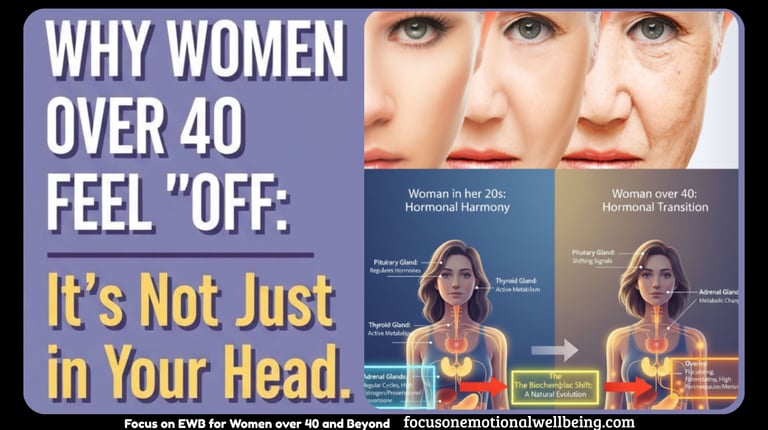
If you’ve found yourself thinking, “Why don’t I feel like me anymore?” please hear me: you are not imagining it, and you are not “too sensitive.”
I work with women in their 40s, 50s, and 60s every day, and I hear the same words again and again: off, flat, wired-but-tired, anxious for no reason, brain fog, low patience, low motivation, and sleep that isn’t restorative. Many women blame themselves. They assume it’s stress, personality, ageing, or a lack of discipline.
But there’s often something deeper happening—something biological and very real.
In midlife, your body enters a biochemical shift where hormones change (often unpredictably), your stress response can become more reactive, and the same life you managed well at 35 can suddenly feel unmanageable at 45. That doesn’t mean you’re failing. It means your internal settings are changing.
My mantra remains simple: Hormones change our bodies. Habits change our epigenetics.
The “Off” Feeling Has a Name: The Menopause Transition
For many women 40+, the “off” feeling is connected to perimenopause—the transition phase before menopause—when ovarian hormone production becomes more variable. Perimenopause can begin years before periods stop, and symptoms are not limited to hot flashes.
According to major health authorities, the menopause transition can affect sleep, mood, energy, cognition, and overall well-being—sometimes before you even realize hormones are involved. Common experiences include:
Irregular periods
Hot flashes/night sweats
Sleep disturbance
Low mood or increased anxiety
Brain fog and forgetfulness
Changes in libido
Body aches, headaches, or increased sensitivity to stress
What I want you to take from this is: if you’re noticing emotional and physical changes at the same time, it’s not “all in your head.” Your brain and body are part of the same system.
Why It Can Feel Emotional (Even When Life Is “Fine”)
One of the most confusing parts of midlife is that your emotions can intensify even when nothing dramatic has changed externally. Here’s why that can happen:
1) Hormone fluctuation affects the brain
Oestrogen interacts with brain systems involved in mood regulation, sleep, and cognition. When hormone levels fluctuate (rather than simply “drop”), you may feel emotionally “unstable” or unlike yourself.
2) Sleep disruption changes everything
Sleep issues are common during perimenopause and menopause. And when sleep is lighter or fragmented, your stress tolerance drops. The result can look like:
more irritability
more anxiety
lower resilience
cravings and energy crashes
worse brain fog
This is physiology, not weakness.
3) The stress response can become more sensitive
When your nervous system is running in high alert (fight/flight), even small demands can feel huge. Many women describe this as: “I’m overwhelmed by things that never used to bother me.”
That’s not a character flaw. That’s nervous system load.
The “Biochemical Shift”: Why Your Usual Habits Stop Working
Many high-functioning women come to me frustrated because their “healthy routine” suddenly isn’t enough. They’re still doing the workouts. Still eating fairly well. Still pushing through. Yet they feel worse.
Midlife often requires a strategy shift—from punishment-based wellness (“push harder”) to regulation-based wellness (“support the system”).
This is where the three pillars we teach at Focus on Emotional Well‑Being matter most:
Physical well-being (sleep, movement, nourishment, pain management)
Emotional well-being (nervous system regulation, stress skills, self-compassion)
Social well-being (support, boundaries, community, reduced isolation)
When hormones fluctuate, your body may need more recovery, not more pressure.
What You Can Do This Week (Practical, Gentle, Evidence-Informed)
You don’t need to overhaul your life overnight. Start with small, consistent steps that calm the stress response and support stable energy.
1) Track patterns—without obsessing
For 7–14 days, note:
sleep quality
mood (especially anxiety/low mood)
cycle changes
hot flashes/night sweats
energy dips
triggers (caffeine, alcohol, late meals, overtraining)
This helps you see cause-and-effect and gives your clinician better information.
2) Protect sleep like it’s treatment (because it is)
Choose one:
consistent wake time (even if bedtime varies)
reduce late-night scrolling
cool, dark bedroom
wind-down routine (breathing, stretching, journaling)
If you wake at 3 a.m. with a racing mind, you’re not broken—your nervous system is activated. We can work with that.
3) Add “nervous system snacks”
Short regulation practices throughout the day can lower stress load:
slow breathing (longer exhale)
a 10-minute walk outdoors
gentle stretching
grounding (feet on the floor, name 5 things you see)
Small inputs, repeated often, create big change over time.
4) Get informed support (medical + holistic)
If symptoms are impacting quality of life, it’s appropriate to discuss options with a qualified clinician. Guidance from bodies like NICE emphasizes individualized assessment and management for menopause-related symptoms, which may include lifestyle approaches and, for some women, hormone therapy where appropriate.
You deserve care that takes your symptoms seriously.
When to Seek Help Urgently
Please seek prompt professional support if you experience:
persistent low mood, hopelessness, or panic
thoughts of self-harm
sudden severe symptoms (chest pain, fainting, neurological changes)
heavy bleeding or bleeding after menopause
You are never meant to white-knuckle your way through this.
A Closing Note From Me to You
If you’re a woman over 40 and you feel “off,” I want you to consider a kinder, more accurate explanation than self-blame:
Your body may be navigating a hormonal transition + a nervous system under strain + real-life responsibilities that are often invisible to everyone else.
There is nothing “crazy” about responding to biology.
And there is so much we can do—together—one habit at a time.
SEO Keywords (naturally included)
Women over 40, feel off, perimenopause symptoms, menopause transition, hormonal changes, anxiety in perimenopause, brain fog, fatigue, nervous system regulation, holistic wellness for women 40+, emotional well-being, sleep problems in menopause, stress response, midlife health.
Google Analytics Note (how I’d use it for this post)
To improve performance, I’d track in GA4:
Average engagement time (are readers reaching the “What You Can Do This Week” section?)
Scroll depth (via event tracking) to see where readers drop off
Outbound clicks (to your audiobook/coaching pages)
Top search queries (via Search Console + GA4) to refine headings/keywords
Conversions (newsletter sign-up, free resource download, consult booking)
References (U.S./U.K. reputable sources)
NICE (U.K.). Menopause: identification and management (NG23), updated Nov 2024. https://www.nice.org.uk/guidance/ng23
Office on Women’s Health (U.S. HHS). Menopause symptoms and relief. https://womenshealth.gov/menopause/menopause-symptoms-and-relief
RCOG (U.K.). Treatment for symptoms of the menopause (patient information). https://www.rcog.org.uk/en/patients/patient-leaflets/alternatives-to-hrt-for-symptoms-of-the-menopause/
NHS (U.K.). Menopause information and symptom overview (NHS resources). Example: https://www.nhs.uk/conditions/menopause/
BLOG
Focus on Emotional Well-Being: Holistic Wellness for Modern Woman 40+ © 2026
Created by Elis Castro (UK/USA Mental Health Practitioner and Specialist in Emotional Well-Being)
⚠️ Professional Disclaimer
I am a mental health professional specialising in Emotional Well-being, but I am not your doctor. Before starting or stopping any supplementation or medication, you must consult your physician or nutritionist to undergo blood tests. Supplements can interact with medications (such as antidepressants or blood thinners). This information does not replace professional medical advice. Always seek the guidance of a physician or qualified nutritionist prior to beginning supplementation.

